Become a professional in Industrial Engineering through Mapúa’s courses in the Philippines that shape the success of future innovators and industry leaders.

关于马普瓦
The A.Y. 2026-2027 online application for incoming Grade 11 and College freshmen are now open. Click here to begin!
Experience Innovative Industrial Engineering at Mapúa
Mapúa University’s BS Industrial Engineering in the Philippines is designed for those interested in integrating multiple disciplines with engineering. The degree equips students with skills to design, improve, and manage integrated systems involving people, materials, information, equipment, and energy.
The program runs for 3 1⁄2 years on a full-time basis. During this time, it trains students on enhancing systematic processes through statistical analysis, interpersonal communication, design, planning, quality control, operations management, computer simulation, and problem-solving.
Industrial Engineering students at Mapúa also benefit from global exposure through international plant visits and valuable internships. They also access advanced facilities like the IE Applications Lab and the IE Methods and Ergonomics Lab, enhancing their practical learning experience.
Recognized by the CHED as a Center of Development and accredited by the ABET Engineering Accreditation Commission and PTC-ACBET, this Bachelor of Science in Industrial Engineering program prepares students for diverse careers. Graduates are qualified for professions in data analysis, manufacturing operations, waste management, occupational safety, consulting and computer automation, healthcare services, and distribution and logistics.
Ready to apply? Click here!
Blended
Learning Mode
August
Start of Classes for the First Term
11
Scholarships
4 Years
Program Length

5. Identify, formulate, research literature, and analyze complex engineering problems, reaching substantiated conclusions using first principles of mathematics, natural sciences, and engineering sciences.
6. Apply ethical principles and commit to professional ethics and responsibilities and norms of engineering practice.
7. Communicate effectively on complex engineering activities with the engineering community and with society at large, such as being able to comprehend and write effective reports and design documentation, make effective presentations, and give and receive clear instructions.
8. Understand and evaluate the sustainability and impact of professional engineering work in the solution of complex engineering problems in a societal and environmental context.
9. Recognize the need for and have the preparation and ability to engage in independent and life-long learning in the broadest context of technological change.
10. Apply reasoning informed by contextual knowledge to assess societal, health, safety, legal, and cultural issues and the consequent responsibilities relevant to professional engineering practice and solutions to complex engineering problems.
11. Create, select, and apply appropriate techniques, resources, and modern engineering and IT tools, including prediction and modelling, to complex engineering problems with an understanding of the limitations.
12. Demonstrate knowledge and understanding of engineering management principles and economic decision-making and apply these to one’s own work, as a member and leader in a team, to manage projects and in multidisciplinary environments.
13. Ability to design, develop, implement, and improve integrated systems that include people, material, systems, information, equipment, and energy.
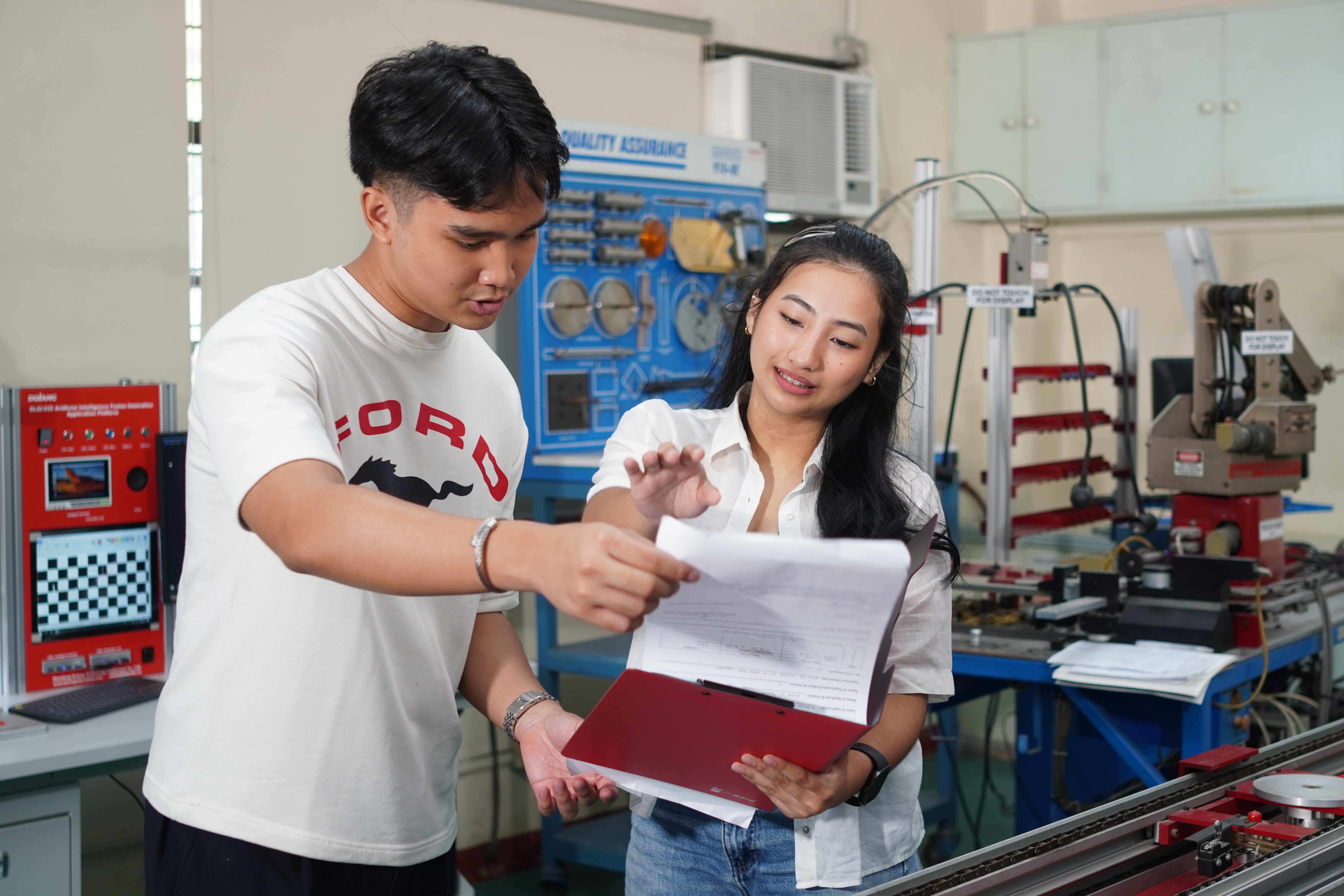
Industrial engineers streamline processes and optimize systems, using skills developed from their bachelor’s degree in industrial engineering to improve productivity and reduce costs in organizations.
Production managers oversee manufacturing operations, ensuring efficient workflows. Graduates of an industrial engineering course are well-prepared to optimize production lines and manage teams in this role.
Project Engineer Project engineers manage timelines, resources, and budgets to ensure efficient project completion. A strong foundation from an industrial engineering course in the Philippines equips them for this role.
Quality engineers maintain product standards and ensure compliance with regulatory requirements. Their expertise, rooted in their Bachelor of Science in Industrial Engineering, allows them to enhance quality control systems.